Thursday, September 13, 2007

10 Tips for a Killer Presentation

10 Tips for a Killer Presentation

Presentations are something that we're all familiar with. Whether you are watching a presentation or giving a presentation, chances are you know what sucks and what doesn't. However, in case you don't know the suck from the not, here are ten tips to help insure you are giving a good presentation:

  1. Don't abuse your visuals - Usually your visuals are posters, charts, or even a PowerPoint presentation. Whatever your visuals may be, keep them simple and don't put too many words on them. The audience isn't there to read your slides, they are there to listen to you present.
  2. Look at the audience - If you ever wondered where you should be looking when presenting, the answer is right in front of you. Don't just single out one person, but instead try to make eye contact with numerous people throughout the room. If you don't do this then you aren't engaging the audience, you are just talking to yourself. This can result in an utter lack of attention from your audience.
  3. Show your personality - It doesn't matter if you are presenting to a corporate crowd or to senior citizens, you need to show some character when presenting. If you don't do this you'll probably sound like Agent Smith from the Matrix. Nobody wants to hear him present. (If you do, you are probably an agent yourself and we will find you)
  4. Make them laugh - Although you want to educate your audience, you need to make them laugh as well. I learned this from Guy Kawasaki and if you ever hear any of his speeches you'll understand why. In essence, it keeps the audience alert and they'll learn more from you than someone who just educates.
  5. Talk to your audience, not at them - People hate it when they get talked at, so don't do it. You need to interact with your audience and create a conversation. An easy way to do this is to ask them questions as well as letting them ask you questions.
  6. Be honest - A lot of people present to the audience what they want to hear, instead of what they need to hear. Make sure you tell the truth even if they don't want to hear it because they will respect you for that and it will make you more human.
  7. Don't over prepare - If you rehearse your presentation too much it will sound like it (in a bad way). Granted, you need to be prepared enough to know what you are going to talk about but make sure your presentation flows naturally instead of sounding memorized. Usually if you ask experienced speakers what you shouldn't do, they'll tell you not to rehearse your presentation too much because then it won't sound natural.
  8. Show some movement - You probably know that you need to show some movement when speaking, but naturally you may forget to do so. Make sure you show some gestures or pace around a bit (not too much) on the stage when speaking. Remember, no one likes watching a stiff. People are more engaged with an animated speaker.
  9. Watch what you say - You usually don't notice when you say "uhm", "ah", or any other useless word frequently, but the audience does. It gets quite irritating; so much that some members of the audience will probably count how many times you say these useless words.
  10. Differentiate yourself - If you don't do something unique compared to all the other presenters the audience has heard, they won't remember you. You are branding yourself when you speak, so make sure you do something unique and memorable.

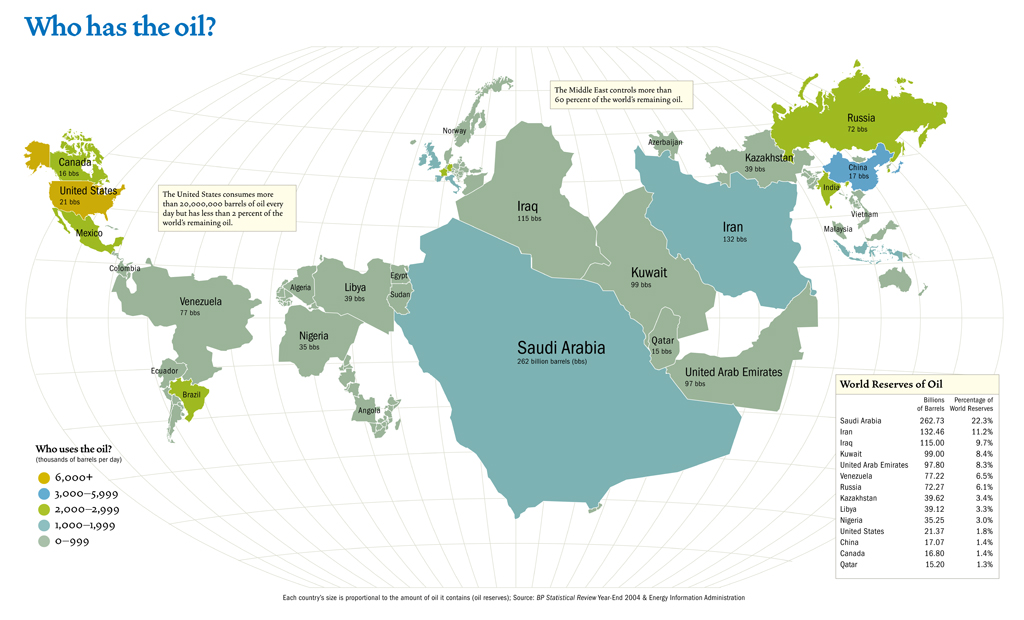
Oil map

Who Has the Oil & who uses it?

This little image shows the reason for so many things in this world…

Monday, September 10, 2007

Meizu M8 vs. Apple iPhone

Meizu M8 vs. Apple iPhone

Since the iPhone's announcement back at the Macworld Expo in January this year, there have been a number of following announcements from various manufacturers of their own iPhones, thereafter labeled as "iPhone Killers" by the media. It's always flattering for Apple to have its own products listed as the standard for that area of the market, but is it necessarily true? In the case of the iPod it certainly is, as it's currently the single most popular MP3 player in the world, dominating the music scene with its partner in crime, iTunes. But the iPod has been out for 6 years and the facts and figures are there to prove its dominance and title of "the one to beat," so how can a phone not yet given an exact release date be given the same title?

A number of manufacturers that have submitted their own entries into the iPhone-killing-market include Samsung, with its F700 touch screen SmartPhone, LG and its KE850 Prada mobile phone (also touch-screen), and the Neonode's N2.

However, one phone that has caught my attention out of all of the ones announced is the Meizu M8 MiniOne, which certainly gives the iPhone a run for its money.

Today I'm going to compare the two phones and show you how the iPhone is given a beating by the M8, but isn't quite knocked out just yet—here's to hoping Steve Jobs can convince enough people that Apple's phone is more worthwhile than the Chinese company's M8.

The Look

One thing many people will notice upon first glancing at the M8 is the similarity to the iPhone, both in terms of hardware and software aesthetics.

imageimage

Meizu M8 (left) compared to Apple iPhone

In terms of hardware, apart from the 0.3 megapixel camera on the front of the M8, both phones have a similar style with a neat little slot for the headphone at the top and a single "home" button at the bottom of the face of the phone. Although the M8 is slightly smaller in height than the iPhone, and thus has a smaller screen, the overall widths and depths are virtually identical, with the M8 coming in at 105 (h) x 57 (w) x 11.5 (d) mm to the iPhone's 115 (h) x 61 (w) x 11.6 (d) mm.

As far as software is concerned it's a little hard to compare right now, as neither phone has actually been released for testing, but with the screenshots below you'll see that the layouts are rather similar, despite Windows CE 6.0 running on the M8 where the iPhone is running the almighty OS X.

imageimage

The Specs Comparison

Dimensions:
iPhone = 115 (h) x 61 (w) x 11.6 (d) mm
M8 = 105 (h) x 57 (w) x 11.5 (d) mm

Screen Size:
iPhone = 3.5 inches
M8 = 3.3 inches

Screen Resolution:
iPhone = 320 x 480
M8 = 720 x 480

Input Method:
iPhone = Apple patented Multi-touch
M8 = Standard touchscreen

Storage:
iPhone = 2 models at 4GB and 8GB non-removable flash memory
M8 = 2 models at 4GB and 8GB non-removable flash memory

Camera:
iPhone = 2.0 megapixels
M8 = 3.0 megapixels plus one 0.3-mega pixels on front for video calling

GSM:
iPhone = Quad-band 2.5G
M8 = Unknown but 3G capable

Wireless Data:
iPhone = Wi-Fi (802.11b/g), EDGE, Bluetooth 2.0
M8 = Bluetooth 2.0 + TV-Out

Operating System:
iPhone = Mac OS X Mobile
M8 = Windows CE 6.0

At this point it's unfair to compare battery life as we don't know for sure what type of battery is being used on the M8 and how long it will last during normal use, but we do know that the iPhone has a pretty poor battery life of 5 hours talk time (compared to a basic 7 hours on most other phones) and up to 16 hours audio playback (or a combination of the two). The iPhone does, however, contain a few more features (listed below) that clearly beat the M8, but some of the features available (sensors) aren't 100% necessary, unless the battery life on the iPhone really is that bad, in which case they are.

One thing that does bother me about the iPhone is its poor camera. Okay, as one user had commented on AM earlier this week, anyone serious about photography wouldn't be using a mobile phone to take pictures, but by the time Apple gets around to releasing the iPhone the 2 megapixel camera will already be out of date.

As far as its 2.5G standard, I honestly don't see this selling well in Europe, where any top of the range phone without 3G is not heard. Video calling, high speed internet, and fast MMS is what it's all about over here and 2.5G standards just aren't good enough. Apple should seriously consider giving the iPhone 3G standards before releasing it over in Europe.

The Price and Options

While you can take the above specs "war" with a pinch or two of salt, the pricing and options available for each phone are pretty eye-opening, considering what you're being given. I think it's also important to say at this point that the iPhone's higher price tag can be somewhat justified given the iPod integration (better speakers), motion and proximity sensors, and the fact that we're being given a tried, tested, and reliable operating system to use.

The iPhone comes in two versions, one with 4GB of memory and one with 8GB of memory, the price coming in at $499 and $599 respectively. However, the M8 has four options available.

As with the iPhone there are two memory models available at 4GB and 8GB, with those prices coming in considerably cheaper than the iPhone at $307 and $398 respectively, but there are also two other versions available without a built-in camera, knocking the price down even further. The 4GB model here comes in at $193 and $284 for the 8GB version. As you can see, price- and options-wise there is one clear winner here.

Summary

All in all in the phones are pretty similar, but while the iPhone raises an eyebrow or two with its fancy spec sheet, the same can be said for its rather high price tag. The M8 is almost a "Windows" clone of the iPhone that comes in at a much cheaper cost, also giving you more options (camera or not) allowing you to adjust the cost accordingly. If you're after the iPhone but just can't afford it, the M8 appears to be there to clean up.

If it's music you're after the iPhone is clearly the better option, but with a higher resolution screen and better camera, videos and photos will be more suited to the M8, so perhaps that is something to take into consideration before making a purchase of either. Once again, details are still unclear on the M8 so it's probably not fair to compare the software side of things right now, but I have no doubt Apple Matters will bring them to you the moment they arrive.

So what do the readers of AM think? Is the M8 virtually a cheaper but equally competent version of the iPhone, or is it literally a cheap ripoff? For those that seriously considered buying the iPhone, could you now see yourself changing your mind and opting for the M8 instead?

Sunday, September 09, 2007

Rolling Stone: The Real Liberal: John Edwards

The Real Liberal: John Edwards is Third in the Polls, But Don't Count Him Out

Tim Dickinson Posted Aug 10, 2007 1:03 PM

National Affairs john edwards hilary clinton barak obama Photo

John Edwards may rank third in the polls, but his progressive agenda and old-school campaign have given him the edge in the states that count.

If he weren't rich, handsome and so well married, you might feel a little sorry for John Edwards. Never before in the 231-year history of our republic have the inalienable traits that Edwards possesses -- his fair skin and a Y chromosome -- been anything but a prerequisite for presidential politics. Today, his race and gender stand a chance of derailing his campaign altogether. "There's a lot of democrats who would like to make history," says Markos Moulitsas, founder of the influential online forum Daily Kos. "The party is anxious to nominate a black or a woman," agrees Dick Morris, the former adviser to Bill Clinton. "You have to sign off on either of those two options before you even get to voting for Edwards." Indeed, Edwards has been all but eclipsed by the celebrity candidacies of Hillary Clinton and Barack Obama: He ranks a distant third in national polls, and his $12 million cash on hand is barely a third of Hillary's and Obama's hauls.

But counting Edwards out would be a big mistake. Flying below the radar, the former vice-presidential candidate is pulling off a feat that Democratic consultants have long considered impossible: staking out the most progressive platform among the viable candidates while preserving an aura of electability. In head-to-head polling against the likes of Rudy Giuliani and Mitt Romney, Clinton and Obama have managed to post only modest leads. Edwards, by contrast, not only bests every Republican candidate in the race, he trounces them -- by an average of twelve points.

"Edwards' message is more left than it was in '04, and it's attracting the right kind of people for the primaries," says Bill Carrick, a veteran party strategist. "But the general electorate still sees him as mainstream. He's doing a good job of threading that needle."

While Clinton and Obama are running media-age campaigns that focus on big ad buys in delegate-rich states, Edwards is taking a decidedly old-school approach. In a strategy reminiscent of the way Jimmy Carter captured New Hampshire in 1976, Edwards has focused on building grass-roots support in Iowa, Nevada, New Hampshire and South Carolina -- the first four Democratic contests, all of which will be held in January. Working out of the national spotlight, he has established a sizable lead in the state where a victory in 2004 effectively clinched John Kerry's nomination. "Edwards could well win Iowa," says James Carville, the former adviser to Bill Clinton. Thanks to his Southern roots and a deep relationship with organized labor, Edwards would then become the candidate to beat in both South Carolina and Nevada -- victories that would establish him as the front-runner a week before the huge "national primary" scheduled for twenty states on February 5th. "If he wins Iowa and New Hampshire," says Chris Lehane, a top strategist for both Kerry and Al Gore, "He'll have such a head of steam he'll be unstoppable."

It's a smoggy Monday in late June, and Edwards is padding down a backstage hallway at NBC Studios in Burbank wearing purple jogging shorts and a blue T-shirt soaked with sweat. His grin, away from the cameras, is easy and unguarded, the weight of the campaign swept aside by the buzz of endorphins from a three-mile run. Stripped of his trademark chinos and blue blazer, Edwards is built like a point guard, taller and leaner than you'd expect. His goal this afternoon is to break down the defenses of his TV nemesis: Jay Leno, who has spent months skewering the candidate for his $400 haircut. John Edwards "said it was a mistake," goes one Leno line -- "especially in the back, where they didn't feather enough."

The Tonight Show offers Edwards a rare opportunity to move beyond the beauty-shop jokes and lay out something that has received only glancing national attention: his agenda. If you last tuned in to Edwards during the son-of-a-mill-worker days of 2004, the difference in his vision will surprise you. Gone is the cautious centrist groomed by uberconsultant Bob Shrum as a sort of Bill Clinton Lite. For 2008, he has been replaced by what the campaign hopes will play as the Real John Edwards, a shoot-from-the-hip progressive who won't scare away moderates. "Incremental steps don't work," Edwards says today. "We are not in that place in America anymore. We need huge changes. And it's going to require a president and a people who are willing to do some things that may feel dangerous in the short term."

Take global warming: While Clinton spouts happy talk about ethanol and "clean coal," and Obama focuses on a technocratic proposal to lower the "carbon intensity" of auto fuel, Edwards has a plan that would make the Union of Concerned Scientists proud. "We need an eighty percent reduction in greenhouse emissions by 2050," the candidate told Rolling Stone in a wide-ranging interview. "You start by capping carbon emissions in America. Beneath the cap, you auction off the right to emit any greenhouse gases. And you use that money --$30 to $40 billion -- to transform the way we use energy."

Or poverty. Ending deprivation at home -- by making it easier for workers to unionize, raising the minimum wage to $9.50, cracking down on predatory lending, and providing matching funds to help low-income Americans save -- remains the hallmark of his candidacy. But informed by his travels in Africa, Edwards now proposes spending $5 billion a year to educate 100 million children worldwide, improve drinking water and sanitation in developing countries, and slow the ravages of HIV and AIDS.

When he's not echoing Bono and Al Gore, Edwards sounds a bit like Michael Moore. He was the first contender with a plan for universal medical coverage, and his proposal goes further than Obama's by mandating that every American be provided a health plan. And where Clinton would leave a significant troop presence in Iraq indefinitely, Edwards calls for a complete withdrawal. He has issued the most forceful repudiation of Bush's "war" on terror, and in July he proposed a tax hike for wealthy investors.

"Edwards is swinging for the fences," says Peter Leyden, director of the New Politics Institute, a progressive think tank. "He's got strategy reasons for doing that -- he's got to get on the board differently. But given where we are as a country right now, his transformative rhetoric is right on the money."

Such unabashed progressive stances have made Edwards a hit among the party's Netroots activists. His climate-change plan was the runaway favorite in a MoveOn.org straw poll that followed the Live Earth concerts. And in a recent survey of more than 16,000 Democrats on Daily Kos, Edwards emerged as the top choice, registering forty percent support to Obama's twenty-two percent. "Edwards' proposals go the furthest -- they're like the ideal," says Moulitsas of Daily Kos. "Everybody else is playing it so safe it's dreadful."

The Edwards campaign presents his progressive evolution as a return to his core beliefs. "In 2004 he was consultant-driven," says Moulitsas. "In his gut he was against the war, but Bob Shrum talked him into co-sponsoring the authorization." That line is echoed by the candidate's chief adviser: his wife, Elizabeth. Sitting in a stuffy dressing room at The Tonight Show, she tells Rolling Stone that her husband is no longer deferring to consultants. This time, she says, "He's reaching for the brass ring."

Elizabeth Edwards has emerged as the campaign's liaison to the activist base, reaching out to constituencies that the candidate can't court directly. In June, ignoring her husband's nuanced support for civil unions, she openly endorsed gay marriage at San Francisco's pride parade. She also serves as the campaign's chief attack dog. In our couch-side chat at The Tonight Show, she launches a broadside against Clinton, accusing the senator of "not addressing women's issues. Health care is a woman's issue; the face of poverty is a woman's face. Yet she's got nothing on these issues. Where are the programs? They're completely missing."

But the pivotal question is how the candidate's progressive stance will play in Iowa: Unlike Clinton and Obama, Edwards has no other options. "He's only got one strategy -- he's got to win Iowa," says Carrick, who was a key adviser to Dick Gephardt in 2004. "If you get that slingshot effect out of Iowa, you can really take off in New Hampshire." Win them both, history suggests, and you're a lock for the nomination. "Edwards has a game plan," says Lehane. "You can see how it can work if everything comes into alignment."

To solidify his support in Iowa, Edwards has been quietly crisscrossing the state for the past two years, cultivating local party leaders and dropping in at picnics and ice cream parlors in towns like Tama and Sac City. "He's been campaigning in Iowa ever since 2004," says Gordon Fischer, a stout, goateed Des Moines lawyer who served as the Democratic chair in Iowa in 2004. "He never left." Edwards was the first candidate, on either side of the aisle, with campaign chairs in each of Iowa's ninety-nine counties. The Clinton campaign, by contrast, produced an internal memo that floated the idea of bypassing Iowa altogether and focusing instead on "winning this new national primary" on February 5th.

Iowa plays to Edwards' gifts as a trial lawyer, speaking to small groups in the state's 1,800 precincts. "Coming from North Carolina, he's particularly effective communicating to conservative Democrats in rural Iowa," says Fischer. "He's leading in the polls, and he's got the most superior organization -- head and shoulders above the others." Much of that organization comes from those he calls his "brothers and sisters" in organized labor. Where the failed Gephardt campaign staked its political fortunes in Iowa to the declining industrial unions, Edwards has forged ties to the rapidly expanding unions that represent government and service workers.

Indeed, no Democrat has made a stronger play for union backing than -- Edwards: Since 2004, he has participated in more than 180 labor events -- including a hunger strike for immigrant janitors in Miami -- for twenty different unions. In 2006, while Clinton was burning through $30 million on her shoo-in re-election campaign in New York, Edwards was campaigning for initiatives to increase the minimum wage in six key states. While other candidates have little time for labor-hall rallies -- the PR firm of Clinton's chief strategist, Mark Penn, has actually engaged in union busting -- Edwards has made labor a central element of his anti-poverty campaign. On the stump, he calls collective bargaining the key to "making work pay" and lifting low-wage Americans out of poverty.

"This is a true commitment on his part," says Anna Burger, chair of the labor federation Change to Win. "He was doing this when there were no cameras watching him. We needed a spotlight on workers, and anything he could do to raise their profile, he was willing to do that. His special relationship with labor is forcing the other candidates to play catch-up."

Union support could pay off big in Nevada, where the hotel and service workers in the casinos of Las Vegas and Reno offer Edwards the kind of organizational muscle money can't buy. "The unions are going to own the Nevada caucus," predicts Moulitsas. "It's all about organization. So there's a very strong possibility Edwards will take Iowa and then Nevada. That would give him real momentum going into New Hampshire."

Veteran strategists agree that Edwards will need every bit of it. "As good as his operation is in Iowa, Hillary is as good if not better in New Hampshire," says Lehane. But unlike 2004, when Edwards had only seven organizers on the ground in New Hampshire, he is now deploying forty. Nor is the Granite State a lock for anyone: The candidate who led one recent poll here isn't even a candidate -- it's Al Gore. It requires no great leap to imagine that many would-be Gore supporters will ultimately gravitate to the other white male Southerner with a serious plan for global warming.

Such considerations of race and gender can't be overlooked, says Leyden of the New Politics Institute. "Obama and Clinton are terrific candidates," he says, "but they each represent an untested threshold in American politics. You have to entertain the idea that when Democrats really think about who is going to ensure that the party wins in 2008, a lot of people might get nervous and say, 'Damn it, we need a good-looking, charismatic white guy.' I hate to be crass. But that's baldfaced politics."

Edwards himself takes pain not to play the race or gender cards directly, saying only that "we must nominate a candidate who will win the general election." The unstated implication is that, while racism and sexism would hurt Obama and Clinton in November 2008, Edwards could run strong in the South -- particularly against Northerners like Romney or Giuliani. "You get a Southerner against a former Massachusetts governor or former New York City mayor, and you've really got a cultural dichotomy that is tough on the GOP," says Carrick. "It's enough to make a Republican strategist suicidal." Edwards is also careful to temper his progressivism with more centrist positions. Speaking to Rolling Stone, Edwards refused to rule out recommitting U.S. forces to Iraq to halt a genocide, and he even demonized single-payer health care: "Do you think the American people want the same people who responded to Hurricane Katrina to run their health-care system?" On The Tonight Show, Edwards also played it down the center, soft-pedaling global warming and trumpeting his anti-poverty credentials.

The appearance didn't move the needle on his poll numbers, but it may have helped him turn the page on that disastrous haircut. Two weeks after the show aired, Edwards was still featured in Leno's monologue -- but now another politician was on the business end of the punch line. "Senator John Edwards began what he's calling his poverty tour today," Leno announced. "He's visiting people who have no money and no hope. His first stop: John McCain's campaign headquarters."

Rollingstone: The War Party

The War Party

Unrepentant over the GOP's disastrous invasion of Iraq, Republican candidates are determined to stay the course - and change the subject

Matt Taibbi Posted Sep 06, 2007 10:06 AM

Quietly and miserably, like an anxious mother tiptoeing away from an autistic child who has fallen asleep with his helmet on, the Republican Party continues its hopeless search for a viable nominee while backpedaling from its own disaster in Iraq. The candidates, all of them -- I exclude here Congressman Ron Paul, who is an uninvited guest to this ball -- are fourth-rate buffoons, not one of them qualified to hold down the last ten minutes of a weekday open-mike night in a Skokie comedy club. They are divided into two categories: those who try to avoid talking about Iraq by saying nothing at all, and those who try to avoid talking about Iraq by talking loudly about something else.

One Monday a few weeks back in Newark, New Jersey, I met one of the members of the latter group, Rep. Tom Tancredo. The vengeful Colorado midget's rap is immigration, i.e., convincing Middle America that the War on Terrorism is actually taking place in Mexico. But when he shows up in the ugliest city in America to gloat about three kids allegedly murdered by illegals from Latin America, he is greeted by a crowd of pro-immigrant protesters chanting, Tancredo! You liar! We'll set your ass on fire! They're yelling so loudly that no one can hear Tancredo speak from a distance beyond two feet.

The actor Paul Winfield was once asked what was the artistic key to his performance as Don King in a made-for-HBO movie about Mike Tyson. Winfield shrugged and held up his spiky Don King wig. His was a one-trick performance. Tancredo also has only one trick on the campaign trail. Whenever he mentions the words "illegal aliens," he follows them with the word "including." As in:

"Sanctuary cities," he says in Newark, "are safe havens for all illegal aliens, including gang members, drug dealers, rapists and murderers, further exposing the law-abiding citizens of such a city to greater crime." In other words, who cares about Iraq when you might get raped by a Mexican busboy?

In the face of the awesome political catastrophe that has befallen the Republican Party in the form of George W. Bush, the response of its new leaders has not been to re-examine their perverted values, their vicious tactics or even their position on Bush's singularly idiotic and supremely characteristic policy mistake, the Iraq War. Instead, the party is closing its eyes and trying, Dorothy-like, to wish its way back to Kansas, back to the good old days of mean-spirited, blame-the-darkies politics of Newt Gingrich, a time when electoral blowouts could be won by offering frightened Americans a chance to pull a lever against gays, atheists and the collective rest of onrushing modern reality.

If this were ten years ago, when America was safely suckling on the Internet bubble and restricting its overseas dabbling to military exhibition games like Kosovo, this back-to-the-good-old-days bullshit would be mere vileness. But thanks to the GOP's excellent leader, Mr. Bush, America is no longer in any position to hide from reality. We are now fully and catastrophically engaged in reality. And reality is kicking our ass, in Iraq and Afghanistan and everywhere else in this world that hates us more and more with each and every passing day. The party's response is to blow that off, pretend it's not happening. Six years after 9/11, Bush's would-be replacements are still reading My Pet Goat. Their solution to the Iraq dilemma is to keep talking tough, as if our kids were not getting arms shot off from Basra to Tal Afar, as if bin Laden weren't still scoring record recruiting numbers in between bong hits on Al Jazeera.

Tancredo's idea for repairing America's relations with the Islamic Middle East is to threaten to nuke the innocent holy cities of Mecca and Medina. "That's the only thing I can think of that might deter somebody from doing what they otherwise might do," he said recently. At the tail end of his Newark appearance, as a means of trying to get him to say something, anything, about the Middle East, I ask Tancredo about that comment.

"That's for a different press conference," he grumbles, and slithers away.

***

Polls may be the devil's currency, near the top of the list of campaign evils, but in this case they tell the whole story. A recent CBS News poll indicates that thirty-one percent of Americans want to begin pulling at least some troops out of Iraq right away. Another thirty percent want to completely withdraw from Iraq, right now. That's nearly two-thirds of the country that wants to start bringing troops home.

Among young people, the numbers are even more striking. According to another poll, voters ages eighteen to twenty-nine now trust the Democrats more than the Republicans on every single issue surveyed, including the War on Terror. A mind-boggling sixty-six percent of young people are against giving the president's Iraq War plan a chance. Even among young Republicans, nearly four in ten favor an immediate withdrawal.

Anyone with an IQ above ten can see what these polls mean; what they should tell the Republican Party is that it simply cannot win a general election unless it changes its tune on Iraq. Instead, after two decades of Reagan-esque macho campaigning, decades in which Republican electoral success so spooked both the national media and the Democratic Party that it became axiomatic that only the toughest-talking and most warmongering politicians had even the slightest chance at the presidency, the Republicans find themselves cornered by their own conventional wisdom. Indeed, they are experiencing a sort of mirror image of the electoral/ideological malaise that has stricken their opponents in recent years. Democratic candidates have generally refused to sell out on social issues like abortion and minority rights but have quickly surrendered on military spending, worker rights and deregulation in a desperate attempt to win swing voters and corporate contributions. Now, with doomed figures like Mitt Romney, Rudy Giuliani and John McCain headlining this season's primary choices, the Republican Party offers the opposite: candidates willing to betray traditional party orthodoxies on abortion and gay rights but unwilling to budge on the toughness thing. After so many years of watching Democrats crucify themselves on the altar of missile envy -- saddling national tickets with pint-size fist-shakers like Joe Lieberman and turning the Kerry convention into a fatigue-clad orgy of Band of Brothers-style grunt-humping -- witnessing this sad procession of stay-the-course Republicans engaged in the political version of the Bataan Death March is a delicious comedy.

To wit: I checked in with former Massachusetts Gov. Mitt Romney outside Orlando, where he gave a speech to local Republicans before opening up the floor for his goofy-ass "Ask Mitt Anything" town-hall routine. Romney is an utter tool; he represents nothing so much as the very banality of our system of campaigning, a poll-chasing stuffed suit with a Max Headroom hairdo who will say (or won't say, for that matter) whatever the fuck it takes to get elected. The winner of the less-than-meaningless Iowa straw poll, he might end up the front-runner solely by virtue of the fact that he lacks the obvious hideous deformities of most of the rest of the field, in particular the human car wreck John McCain and the electoral incarnation of Tommy Lee Jones' acid-bath-surviving Two-Face character, Rudy Giuliani.

Romney's plan is clearly to wear a straight tie, call Hillary Clinton a commie (she's "out with Adam Smith and in with Karl Marx") and say almost nothing else. And it might work; that's what makes his stump shtick so interesting. In Orlando, he surfs through a nervous presentation that carefully avoids the Iraq thing, taking a shot at John Edwards' plan to create a $250 tax deduction for low-income Americans ("It wouldn't buy John Edwards a haircut," he cracks to pseudoapplause, trying not to touch his own perfectly sculpted hair helmet) and railing against those damned perverts the Democrats won't keep from raping our kids. "There are 29,000 convicted sex offenders on MySpace alone!" Romney cries. He's big on the whole protect-our-poor-innocent-children thing, blabbering about how we have to "clean up the water our kids are swimming in."

Not, of course, our kids in Iraq, who have some interesting water of their own to swim in lately, but our poor kids at home who have to brave the real dangers of the Internet, Hollywood movies and men holding hands. Nor, for that matter, Romney's own kids -- five sons who, rather than fighting in Iraq, he said recently, are "showing support for our nation" by working on their dad's campaign.

Of course, some of our kids are enemies themselves; one audience member picked by Romney's staff of breasty volunteer chicks to "Ask Mitt Anything" is a middle-aged white woman with a fine command of Rovian code words. Explaining that she is a teacher who works in a "socioeconomically low" area, she complains that her students are not motivated to get better test scores because, they tell her, "We don't have to work -- we'll get a check just like my mama does." Romney delivers a heartfelt solution to the lazy-Negro problem, saying you can predict which black kids will fail in school by seeing which ones have two parents come to parent-teacher night.

Romney is easy to make fun of, but he knows his business; in a world where bullshit rules the day, he does bullshit better than anyone. Hence, it is significant that this candidate -- who only a few months ago was gamely clutching his balls in a South Carolina debate and making macho pledges to "double Guantanamo" -- has suddenly abandoned his foreign-policy bluster. In Orlando, he doesn't touch Iraq until asked about it in Q&A -- and even then only mumbling something about how "the surge is, in my view, the right thing to be doing." Then it is quickly back to the usual stuff, commies and perverts and immigrants and lazy black people, the real sources of trouble in this country.

After the event, I actually find a few people who express muted enthusiasm for Romney's performance. Jim Broughton, an Orlando native who proudly describes himself as "to the right of Attila the Hun," is a Tancredo man who likes Romney as a second choice. He thinks we should "hurry up and end the war," but Iraq isn't his top concern. "Our culture and civilization, it's under . . . let's just say I don't want to learn Spanish," he says, frowning.

Another man at the event who appears to be mentally disturbed says he likes Romney because the candidate's slogan, "True Strength for America's Future," communicates to him that "the Space Center makes the United States a superpower." And a couple emerging after the speech say they now much prefer Romney to Giuliani; when I ask what they think the difference between the two is, they say they don't know, but that "Romney talks good."

***

There is a joke to be made here, but it's probably best left unmade. Suffice to say that this is not the year for any party to feel positive about relying on voters who are content with "talking good" or who worry more about dirty Mexicans than a bloody trillion-dollar war. But that is where the Republican Party is right now -- and there are signs that some of the candidates are finally collapsing under the weight of this painful equation.

Take rapidly decaying political rape victim John McCain, who has become the symbol of America's newfound impatience with the war. The one-time consensus front-runner was recently humiliated by a poll that shows him trailing Barack Obama among Iowa Republicans. (In fact, Obama outpolled McCain, former Arkansas Gov. Mike Huckabee and U.S. senator/Christian lunatic Sam Brownback combined). Pilloried for his "principled" stand of refusing to give up on the war, McCain is now, hilariously, trying to reposition himself as a war critic. "I was the greatest critic of the initial four years," McCain claimed on CNN, failing to note that his "criticism" is that there are too few troops in Iraq.

McCain has taken the biggest beating in the press for his war stance, but really there is no meaningful difference on Iraq between any of the Republican candidates, who all waver along the same narrow spectrum of embarrassing self-delusion ("the surge is working") and blind idiocy ("taking the fight to the terrorists"). Brownback, a candidate of the Tancredo school who mostly avoids Iraq talk by yammering the loudest about dead fetuses, talks about needing a "political compromise" -- one that does not include withdrawal, that is. Rep. Duncan Hunter is trying to sell war-weary Americans on a really tall fence to keep rape-seeking Mexicans out of San Diego; his Iraq position is the same as everyone else's, except that he stresses the need for more training -- something, apparently, that the Bush administration hasn't thought to try in the past four years.

Huckabee offers the most novel explanation for why the candidates keep skirting the war. "The reason you don't hear a lot of Republicans bringing Iraq up in the front end of their stump speeches is that, frankly, we don't have to," he tells me at a fund-raiser in Great Falls, Virginia. "It seems to dominate so much of our interaction with the media, so therefore, that part's covered pretty well."

Wait, I think. Isn't that . . . bullshit?

"So you're saying," I ask Huckabee, "that if the poll numbers were different, if people approved of the war, you still wouldn't be talking about it in your stump speeches?"

"I think," Huckabee says cheerfully, "that we would be talking about it if there was no other forum in which we could be asked about it."

Yep, that's bullshit, all right. Like the Republican candidates wouldn't all be ramming it down our throats if Bush had turned Baghdad into Geneva, instead of Kinshasa. Like we wouldn't be listening to Rudy Giuliani propose sedition charges against the Dixie Chicks and Michael Moore to roaring crowds in Manchester and Des Moines.

Which brings us to Giuliani. His position, while not substantively different from the others, is certainly interesting from a stylistic perspective. While the other candidates avoid Iraq in their stumpery, Rudy proudly plunges into the issue from the start of his speeches, snarling at crowds like a wild, bald beast. He unabashedly talks about the need to "stay on offense" and howls at the mere suggestion of a pullout, insisting that any withdrawal would be a "terrible mistake" and "worse than Vietnam."

In a testament to the astonishingly low standards of the American voting populace, it appears that this approach is succeeding on the level of "charisma." Giuliani leads his nearest Republican competitor by twenty points and would only lose to Hillary Clinton by six measly points if the election were held now.

Oh, wait, he would still lose, even to a supposed Marxist witch like Hillary Clinton. That's the best-case scenario for the Republican Party at the moment. First they screwed up, sending thousands of Americans to their deaths. Then they refused to apologize. And now they're going to pay.

40+ FREE Windows Apps

Security:

1. Open Antivirus:
OpenAntiVirus is not another virus scanner to put on a computer! OpenAntiVirus is a platform for people seriously interested in anti-virus research, network security and computer security to communicate with each other, to develop solutions for various security problems, and to develop new security technologies.

2. Truecrypt:
Free open-source disk encryption software for Windows Vista/XP/2000 and Linux. Creates a virtual encrypted disk within a file and mounts it as a real disk. Encrypts an entire hard disk partition or a storage device such as USB flash drive. Encryption is automatic, real-time (on-the-fly) and transparent.

3. ClamAV:
ClamAV application is primarily for unix based systems but now a windows version is available. This version needs a emulation layer like CygWin

4. RogueScanner:
RogueScanner is an open source vulnerability management tool that is used to gain greater network visibility. This enables you to quickly identify and remove rogue wireless devices that may provide back door access to your critical data and infrastructure.

5. Keepass:
KeePass is a free/open-source password manager or safe which helps you to manage your passwords in a secure way. You can put all your passwords in one database, which is locked with one master key or a key-disk. So you only have to remember one single master password or insert the key-disk to unlock the whole database.

6. Clipperz:
Clipperz is a free and anonymous online password manager. Local encryption within the browser guarantees that no one except you can read your data. Nothing to install. (earlier review)

7. SoftPerfect Personal Firewall:
The SoftPerfect Personal Firewall is a free network firewall designed to protect your PC against attacks from the Internet or via a local area network. SoftPerfect Personal Firewall offers customizable security using user-defined rules for packet filtering. It works at a low level and also allows you to create rules based on non-IP protocols such as ARP.

File Transfer / Sharing:

1. WinSCP:
WinSCP is an open source free SFTP client and FTP client for Windows. Legacy SCP protocol is also supported. Its main function is safe copying of files between a local and a remote computer.

2. PuTTy:
PuTTY is a free implementation of Telnet and SSH for Win32 and Unix platforms, along with an xterm terminal emulator.

3. ShowMyPC:
ShowMyPC is now a Community for Remote Support providers. Providing tools for Instant Support to Service Providers and Users. It started as an open source Desktop Sharing and Remote PC access project, an alternative to subscription based sites like WebEx or Gotomypc.

4. Ares:
Ares is a free open source file sharing program that enables users to share any digital file including images, audio, video, software, documents, etc.

Multi Media

1. Media Player Classic:
Media Player Classic (MPC) is a compact free software media player for Microsoft Windows. The application has a similar look and feel to the old light-weight Windows Media Player 6.4. Underneath, however, it is a completely different application which has all the options and features one might expect from a modern media player.

2. Media Coder:
MediaCoder is a free universal batch media transcoder, which nicely integrates most popular audio/video codecs and tools into an all-in-one solution. (earlier review)

3. Hanbrake:
HandBrake is an open-source, GPL-licensed, multiplatform, multithreaded DVD to MPEG-4 converter, available for MacOS X, Linux and Windows.

4. musikCube:
musikCube can be an alternative to iTunes to manage your music collection.

5. popCorn:
popCorn is a desktop-oriented MPEG-1 audio (MP3) and video software capable of playing data streamed directly from the network. Compatibility with existing media servers is provided by the support of the industry standard RTSP protocol.

6. ImgBurn:
ImgBurn is a lightweight CD / DVD / HD DVD / Blu-ray burning application. It supports all windows versions.

7. AVS Disc Creator:
Write your data to CD, DVD and Blu-ray Discs quickly and easily using FREE AVS Disc Creator.

8. DVDStyler:
DVDStyler is a cross-platform DVD authoring application that makes possible for video enthusiasts to create professional-looking DVDs.

9. mp3mymp3:
Record any audio playing on your computer as mp3 or wav file with mp3mymp3 recorder. It can record any sound originating from your computer, it works by recording all audio through your sound card. (earlier review)

10. Youtube Catcher:
Youtube Catcher can download videos from Youtube, Google Video, Myspace Video, Yahoo video Dailymotion Stage6 Veoh. The downloaded videos can be exported to various formats like MPG,AVI, MP4,3GP, 3G2, WMV, PSP, MOV, FLV with the quality you choose. (earlier review)

11. Media Portal:
MediaPortal is an Open Source application ideal for turning your PC / TV into a very advanced Media Center. MediaPortal allows you to listen to your favorite music & radio, watch and store your videos and DVDs, view, schedule and record live TV as a digital video recorder and much much more.

Video Editing Tools

1. Vivia-The Video Editor:
Vivia is a video editing program for Linux and Windows. It provides extremely easy editing of clips and transitions in real-time, along with multi-camera support for editing scenes that were recorded by more than one camera simultaneously.

2. MiNi Video Studio:
MiNI Video Studio is a program for non-linear video editing. It means this application allows creating of a movie from other movies in a way, that the elements of the final movie overlap, creating a series of layers, that can be rendered one by one, or all at once.

3. DVD Flick:
DVD Flick aims to be a simple but at the same time powerful DVD Authoring tool. It can take a number of video files stored on your computer and turn them into a DVD that will play back on your DVD player, Media Center or Home Cinema Set. You can add additional custom audio tracks as well as subtitles of your choice.

4. OpenVIP:
OpenVIP editor. It provides a user-friendly GUI to the core and is based on the timeline concept - you place multimedia files on the timeline, apply filters, transitions…

Image Viewing & manipulation

1. Irfanview:
IrfanView is a very fast, small, compact and innovative FREEWARE graphic viewer for Windows 9x/ME/NT/2000/XP/2003/Vista.

2. Paint.net:
Paint.NET is free image and photo editing software for computers that run Windows. It features an intuitive and innovative user interface with support for layers, unlimited undo, special effects, and a wide variety of useful and powerful tools.

3. XnView:
XnView is a free software to view and convert graphic files, really simple to use. It Support of more than 400 graphics formats.

3D Graphics:

1. Art Of Illusion:
Art of Illusion is a free, open source 3D modelling and rendering studio. It is written entirely in Java, and should be usable on any Java Virtual Machine which is compatible with J2SE 1.4 or later.

2. OpenFX:
OpenFX is an Open-Source 3D modeling, animation and rendering suite. A powerful feature-set includes a full renderer and raytrace engine, NURBS support, kinematics-based animation, morphing, and an extensive plugin API.

Office / Productivity

1. AbiWord:
AbiWord is a open source and fully cross-platform word processor.

2. Launchy:
Launchy is a free windows utility designed to help you forget about your start menu, the icons on your desktop, and even your file manager. Launchy indexes the programs in your start menu and can launch your documents, project files, folders, and bookmarks with just a few keystrokes! (earlier review)

3. Cygwin:
Cygwin is a Linux-like environment for Windows. It consists of two parts: A DLL (cygwin1.dll) which acts as a Linux API emulation layer providing substantial Linux API functionality. A collection of tools which provide Linux look and feel.

4. Pandora Recovery:
Pandora Recovery is a powerful free tool that provides its users an effective way to attempt recovery of permanently deleted files. (earlier review)

5. CCleaner:
CCleaner is a freeware system optimization and privacy tool. It removes unused files from your system - allowing Windows to run faster and freeing up valuable hard disk space. It also cleans traces of your online activities such as your Internet history.

6. Wink:
You can create presentations or screencasts with Wink in just minutes, you can record mouse movements or take screenshots of your application and save them as flash files. (earlier review)

7. Freemind:
FreeMind is a premier free mind-mapping software written in Java. The recent development has hopefully turned it into high productivity tool.

8. jetToolbar:
Despite Microsoft's best intentions, the Start Menu isn't everybody's cup of tea. If you're looking for an alternative way to launch your programs, take a look at jetToolBar. During installation this well-done utility creates 14 default categories, registers shortcuts for many of your applications, and adds bookmarks for recommended Web pages.

9. MyUninstaller:
MyUninstaller is an alternative utility to the standard Add/Remove applet of Windows operating system. It displays the list of all installed application, and allows you to uninstall an application, delete an uninstall entry, and save the list of all installed applications into a text file or HTML file.

10. Flashget:
Flashget is a freeware for downloading files. It uses MHT(Multi-server Hyper-threading Transportation) technique, supports various protocols

11. ZScreen:
ZScreen is an open-source screen capture program that allows for region/window/full-screen screenshots. It can FTP screenshots and put the URL in your clipboard in a single keystroke. It supports automatic custom naming conventions with variables. It can also interface with image editing software.

Web / Development

1. PSPad:
PSPad is a freeware programmer's editor for Microsoft Windows operating systems, useful for people who:

2. HTTrack:
HTTrack is a free and easy-to-use offline browser utility. It allows you to download a World Wide Web site from the Internet to a local directory, building recursively all directories, getting HTML, images, and other files from the server to your computer.

3. NOTEPAD++:
Notepad++ is a free source code editor (and Notepad replacement), which supports several programming languages, running under the MS Windows environment.

Google Pack

I haven't listed any of the programs from Google Pack because most of the users are aware of these. Except one or two all the programs in this pack are must have for anybody, if you havn't downloaded google pack get it from here

Miscellaneous

Virtual Box:
VirtualBox is a family of powerful x86 virtualization products for enterprise as well as home use. Not only is VirtualBox an extremely feature rich, high performance product.

Tags:, , , , , ,

Thursday, September 06, 2007

How to Buy a New Car

How To: 13 Step Method For Buying A Car While Controlling The Sale And The Price

shadycardealer.jpgCommenter Keter posted a completely kick-ass 13 step guide to buying a car while maintaining total and absolute control over the sales process. It was so good we're lifting it and posting it to the front page.

1. Pick the exact make and model of car you want.

2. Call around first anonymously (such as calling from work on your lunch hour), and get prices. Tell them you are calling everybody, and the best deal wins. Write down the prices you are given, and note any difference in packages.

3. Pick the dealership you think you want to do business with based on the results of this phone call. Price should not be the decider -- demeanor and gut feel should be....

4. Go to the dealership you absolutely NEVER want to do business with . Nail down the details on the options -- go for "loaded," then whittle it down to find the approximate prices for each option. Make a detailed list with prices. Mark the options you must have and those can do without.

5. Do your research online and compare your pricing research with others and experts. Set an "ideal price" and an "I can live with it" price for the car you want with all the options you want, and again for the car you want with the minimum options you want. You now have a low and high figure for the car.

6. Go get cash or a a pre-approved car loan for something less than the upper amount. Put the cash or check in a blank sealed envelope. Find out ahead of time how to deal with the pre-approved loan if the negotiated amount is less than the amount on the bank check. You do not want to have to leave the dealership to get a new check for a smaller amount, so try to arrange something in advance for this contingency.

7. Call your insurance carrier and tell them you are buying a new car. Do as much of the paperwork ahead of time as possible and determine the hours they can service you so you can avoid delays or surprises at delivery time. (Any delays benefit the dealer.)

8. Go to the dealer you want to deal with -- on a weekday, in the morning. Get dropped off or, ideally, have a friend or significant other go with you. (It always helps to have a witness.) Bring a sack lunch and drinks with you. You're not leaving or letting your attention wander until you have a car.

9. Find the exact car you want. Use your list...this shows you've done your homework. Don't be surprised if your salesman suddenly has to handle an emergency and hands you off to someone else. This is a good sign that you have the upper hand already.

10. Show them the envelope. Tell them you have cash/a pre-approved loan check, and three chances to get it from you if you can drive out by an exact time (by 3 PM is usually good), all paperwork done, taxes paid, and every other fee under the sun taken care of for less than the amount in the envelope. Do not give any hints about the amount, make them name heir price. If it's way out of sight, don't say anything. Just laugh and head for the door. They'll chase you down and give you a much better number. If they don't, go elsewhere.

11. Read everything. Twice. Have your friend do the same. Line out anything you don't agree to or doesn't apply, initial and date this and have the dealer rep do the same. Do not leave any blank spaces. Count the papers and make sure you get copies of all of them. Ask if there are any programs you need to opt out of to avoid being automatically signed up for them. Do whatever is required to opt out.

12. If at any time they give you attitude or BS, walk out. They will chase you down. Tell them they have only one chance left because they gave you attitude. Now they will deal. If they don't, go elsewhere.

13. Try another city if yours is full of slime balls.

Good luck. I don't buy new, but I helped friends buy using this technique, and it really works...but it works only if you truly are willing to walk away...and then refuse to bend when they try to put you off or change the terms. Stay civil, do not let any emotion in. You are on a mission, Marine!

The same technique works for buying a used car, but tell them that you will not talk price until YOUR mechanic looks over the vehicle and gives you a report on it. Watch how much the squirm. I also learned the basics of car inspection, and perform my own pre-inspections right there on the lot -- 90% of used cars have a defect so serious they don't pass 5 minutes of my inspection! The best one (if any) goes to the mechanic.

Have the mechanic lined up for the time you will be needing the car checked out. I prefer to have my mechanic pick up the car from the dealer directly. The mechanic should be one you have had good experiences with previously. NEVER use a mechanic who is near the dealership. I tell my mechanic "check this car like you would if your 16 year old daughter was going to have to drive it to Alaska and back -- alone."

Go back to the dealer with a list of all defects and an estimate to fix them. Negotiate a price adjustment. In some cases, you may agree to let the dealer do the repairs, BUT specifically put in writing that these repairs will be accepted only after a re-inspection by your mechanic and no crappy used or after-market parts will be used.

Figure on devoting at least a month and looking at 200+ cars to find a good used car.

I've bought three truly excellent used cars this way -- all for less than $5000 -- all required minor repairs prior to delivery, and all lasted more than 100K miles with minimal repair costs afterward.

Celeb Mashups

Friday, August 31, 2007

Resume Advice

How to Write a Resume

Also try: How to Write a Cover Letter

Step 1: Before You Write Your Resume

A great resume can help you get a job interview (Photo by Penny Mathews)
  1. A resume provides an overview of your experience and skills. As such, it is an important tool in any job search.
  2. A resume cannot guarantee you a job offer, but a great resume will help you get an interview. So spending the time to make your resume as good as it can be is a worthwhile investment!
  3. Before you begin constructing a resume, take the time to think about your experience and what type of job you're looking for.
    • If you're re-entering the workforce, you may pick a different format than someone who's been working continuously.
    • A recent college graduate will focus more on educational background than an experienced worker.
    • If you're changing careers, you may opt for a different format than someone who is remaining in his current field.
  4. Take a look at some sample resumes online. Boston College , the Wall Street Journal, Vault.com and the University of Florida have some good examples.

Do Research in Your Industry

  1. The type of job you're applying for will also influence the type of resume you write.
  2. If there's a style of resume often used in your desired field, consider using it yourself.
  3. Look at sample resumes from other people in your industry. Is there a section or format they're using? You might want to include it too!

Step 2: Use these Resume Writing Tips

Be honest as you write your resume (Photo by Steve Woods)
  • Here are a few tips to keep in mind as you write or update your resume:
  1. Be honest.
    • It is better to address any gaps in employment than to try to hide them.
    • Lying on your resume may get you into an interview, but you still have to go through a background and references check to land the job.
    • If you state you can perform a task or operate a program you actually don't know, your lie will be exposed.
  2. Write out everything you want to include on your resume. You can trim it down to one page later.
    • Note: If you have over 10 years of work experience that is important and needs to be included, a resume of two pages is acceptable.
  3. Employers often scan or upload resumes into electronic databases. For this reason, simpler formatting is the better route to take:
    • Try to avoid using tables.
    • Use spaces instead of tabs to separate sections.
    • Also avoid italics, underlining and shadowed text.
  4. On that note, perfumed paper, curlicue fonts, and pretty images are all no-nos. You want your resume to stand out, but not for these reasons!
  5. Use easy-to-read fonts and a clear design to make your resume more appealing.

Step 3: Write Your Resume Objective Statement

OWL Sample Objective Statements
OWL at Purdue University Sample Objective Statements
  1. An objective statement is the first thing listed after your personal information.
  2. The objective statement is a sentence or two that sums up your current career goals.
  3. An objective statement is not always a resume necessity, but it can be a handy summary of what you're looking for in a position.
  4. If you're starting your resume from scratch, write your objective statement first. This can help you decide what information to highlight on your resume, even if you ultimately decide not to include an objective statement.
  5. Do not write a generic objective statement; it is more likely to turn off a prospective employer.
    • Example: My goal is to get a rewarding job that pays well.
  6. Your objective statement should relate to the job you are applying for.
    • Example: An experienced public relations consultant, I now seek a position as an account manager where I can utilize my management skills.
  7. Target this statement to the position you're interested in . This is the first information on the page after your name and address, and it should make the case for you being the perfect person for the job!

Step 4: Choose a Resume Style

Consider your experience and desired job when choosing a resume style (Photo by Chris Chidsey)
  1. There are several types of resumes:
  2. You want to think about your situation and create the best resume for your experience and desired job.
  3. Keep in mind that most recruiters want your resume to show your career progression . Therefore, use a chronological or combination resume unless you are in an exceptional situation. If you have no work history or have worked multiple jobs over a short period of time an unconventional format may show you in a better light.
  4. Most resumes should fit on one page. However, if the information is truly important and necessary, two pages is acceptable.
    • If you have less than 10 years' work experience, you should only need a one page resume.
    • It is better to go onto a second page than to leave out important information, such as if you are creating an academic CV and want to include your published works.
    • Do not go onto a second page for unimportant information, like personal hobbies, out-of-date skills and achievements from over 10 years ago.
  5. Pick the the type of resume that is best suited to you and your goals.
    • If you're unsure what type that is, try writing your resume in two or more formats, then ask for feedback from friends or relatives. An objective eye may tell you which format is best for you!

Chronological Resumes

About.com's Sample Chronological Resume
About.com's Sample Chronological Resume, top section
  1. This is the most common type of resume.
  2. It lists your work and educational history chronologically.
  3. The general layout is as follows:
    • Header with personal information (Name, Address, Phone numbers, Email).
    • Objective statement (if included).
    • Career and skills summary (if included).
    • Reverse chronological career listings (include employer names and locations).
    • Educational background (School name, location and your GPA).
      • (Recent graduates may place education ahead of their career listings).
  4. List what you achieved in different positions, not what your job responsibilities were.
  5. Quantify your on the job accomplishments .
    • Instead of writing that you improved customer relations, state that customer satisfaction increased 40% while you were in charge.
    • Explain the size of the company you worked for, the number of people you supervised, and the size of any budgets you managed.
  6. Condense unimportant information. There is no need to list every job you've had since college. You can include a quick summary of those early positions in a section labeled "early career."
    • If you were recognized or honored for work you accomplished, by all means include that- if it is relevant to the job you're applying for now!
  7. If you've been in the workforce for several years, your educational background becomes less important. Trimming this section to the basics will leave more room for other information.

Skills Resumes

OWL at Purdue University Sample Skills Resume
OWL at Purdue University Sample Skills Resume, skills section
  1. Skills resumes allow you to group your work history by skills , not by dates or places of employment.
  2. This kind of resume lets you highlight the skills you think are most important; your resume can lead with the most relevant experience you have instead of the most recent.
  3. This resume style can be particularly useful for someone who is re-entering the workforce, or entering the workforce for the first time, and does not have recent work experience.
  4. It is also well-suited if you are making a big career change, as you can list skills relevant to the job you're applying for.
  5. Write a clear objective statement; this can explain how your skills relate to the job you now seek.
  6. Also make sure to include a career summary; this can explain why you are changing careers or re-entering the workforce.
  7. The general layout is as follows:
    • Header with personal information (Name, Address, Phone numbers, Email).
    • Objective statement.
    • Career summary.
    • Skills groupings.
    • List of places of employment (include employer names, locations, and dates of employment).
    • Educational background (School name, location and your GPA).
      • (Recent graduates may place education ahead of their skill groupings).

Functional Resumes

About.com's Sample Functional Resume
About.com's Sample Functional Resume, top section
  1. A functional resume is very close in style to a skill-based resume, and can also be helpful for recent graduates or people re-entering the workplace.
  2. If you've held many jobs over a short period, a functional resume can help you avoid being pegged as a job-hopper.
  3. More and more people work in temporary and contract positions these days; a functional resume is another way to highlight the skills you used in these positions.
  4. This style lets you demonstrate how your previous work or educational experience has provided you with the appropriate background for the job you're applying for.
  5. You do not need to list your jobs in chronological order ; instead, put the most relevant one(s) first.
  6. You also do not need to list every job you have had in the career listing section; simply include the ones that are relevant.
  7. If you're applying for your first job, by all means include related internships and educational awards- if they truly relate to the job you're applying for!
  8. Include an objective statement, as it can tie the disparate resume elements together.
  9. The general layout is as follows:
    • Header with personal information (Name, Address, Phone numbers, Email).
    • Objective statement.
    • Career and skills summary.
    • Career listings, by relevancy to desired position.
    • Employment history (List all employers here, with dates of employment).
    • Educational background (School name, location and your GPA).
      • (Recent graduates may place education ahead of their career listings).

Combination Resumes

  1. A combination resume mixes the chronological, functional and skills formats .
  2. It's another format used by career-changers and those new to the job market, as you can show why you fulfill the needs of the new position.
  3. It can also be used by older workers, as this format lets you highlight your strongest credentials.
  4. The same holds true for people with employments gaps ; this style lets you focus on what you have achieved, not on times when you were not working.
  5. Make sure to write an objective statement for this format as well.
  6. The general layout is as follows:
    • Header with personal information (Name, Address, Phone numbers, Email).
    • Objective statement.
    • Career summary (if included).
    • Skills summary.
    • Reverse chronological career listing; with a focus on skills relevant to the job you're applying for.
    • Educational background (School name, location and your GPA).
      • (Recent graduates may place education ahead of their skills summary).

Video Resumes

The well-known video resume "Impossible is Nothing"
  1. Job listing sites like Jobster and Vault.com let applicants post video resumes online.
  2. Video resumes are becoming more popular, but some HR departments are reluctant to accept them, not wanting to be accused of bias. Make sure you can use your video resume before making one!
  3. Just like paper resumes, a tailored resume is best here. You want this resume to explain why you're qualified to work in a specific position or industry. An elaborate but unrelated production will not be appreciated.
  4. To make your video resume:
    • Dress as if for a job interview.
    • Speak clearly.
    • Do not make distracting motions.
  5. Begin with your first and last name. You can mention more detailed contact information, but be cautious if the video will appear on a public site.
  6. Then list your educational background.
  7. Next discuss your qualifications, either work-related or educational, for the position (or for the industry) you're applying for.
  8. You can mention any special skills you have, if they relate to the job you're applying for.
  9. End by re-stating your name and thank the watcher for her time.
  • Here's an example of what not to do in your video resume:
Video Resume Parody: Impossible is the Opposite of Possible

Step 5: Tailor Your Resume

  1. It is more and more common to have a resume tailored to each position you are applying for, instead of using a "one size fits all" model.
  2. Your resume should highlight why you are qualified for the position you're applying for.
  3. Remove extraneous information. Do not detail every job experience you have had if it does not relate to the job you're pursuing.
  4. Remember, you want your resume to be only one page (two if you have enough business experience that the extra information is important and relevant)!
  5. Applying to multiple industries and you want to list varied skills? Write different versions of your resume for each type of job. Just be careful not to send the wrong version out for a job, or you may pre-emptively disqualify yourself for that position!

Step 6: Polish Your Resume

  • Now that you've chosen a style and entered your information, it's time to polish your resume!

What Not to Have on Your Resume

  1. Always check for typos and grammatical errors. Then check again. Then have a friend proofread for you. These types of mistakes are easy to fix, and make a big difference in whether or not an employer will consider you for a job!
  2. Do not use "I" or "me"; the reader already knows the resume is about your accomplishments.
  3. In listing your education, only include college and graduate school. The fact that you won a spelling bee in first grade, though commendable, will not help you land a job interview!
  4. Remove out-of-date terms and technology. Being able to change typewriter ribbons is not a hot skill today.
  5. Unless specifically requested to do so by the job posting, do not include references on a resume. You can provide these later in the interview process.

Resume Keywords

  1. With online resume databases and thousands of resumes pouring in via email, many HR departments now perform keyword searches to weed through these submissions.
  2. This means you need to make sure your resume includes relevant keywords to the industry you're in or it may be overlooked.
  3. First, make sure you include the keywords from the job listing you're applying to!
  4. To find other appropriate keywords, study job postings for your field. Chances are the keywords you see cropping up in these ads are also what employers search for.
  5. Other sources for industry keywords:
    • Employer websites
    • Industry-affiliated websites
    • Messageboards and forums about your career sector
    • Government job descriptions like Occupational Outlook Handbook
  6. Only list keywords that apply to you.
  7. Only use words for skills you actually have.
  8. Do not load your resume with multiple keywords saying the same thing; it may help you make it through a database search, but when a human sees the keyword-loaded resume she will immediately put it in the garbage.

Resume Action Words

  1. Now examine the words you used to describe yourself and your job. Do you sound like a dynamic worker any company would be thrilled to have, or like a ho-hum employee?
  2. Action verbs like "built" and "led" are better than passive terms like "worked with" and "helped."
  3. For more verb ideas, check out Boston College's list of action verbs .
  4. Make your resume special by having it really describe who you are. Instead of generic resume words that are overused to the point of meaninglessness, use words and descriptions that are concise, easy-to-read and relate to who you are, what you've accomplished, and what you aspire to for the future. You want your resume to reflect the real you!

Resume Writing Services

  1. The online site Emurse offers an online resume-building template. After registering (for free), you can input your personal information and the site will use a template to create a resume.
  2. Microsoft Word has resume templates and a resume writing wizard you can use. You can also find more resume templates online.
    • Be careful using these, as the formatting may make it difficult for companies to electronically scan your resume.
  3. Check out books about writing resumes, like Resumes for Dummies and The Elements of Resume Style
  4. Professional resume writing services can be useful if you're stuck on what to do. Check out these professional resume writers' groups to find help.

Articles about How to Write a Resume

Have any great tips on How to Write a Resume? Post your thoughts to the discussion board or email them to Sara: sara at mahalo dot com.

Related Searches

How to Write a Cover Letter | How to Nail a Job Interview