Showing posts with label open source. Show all posts

Wednesday, June 27, 2012

Best Home WiFi Routers - Summer 2012


Five Best Home Wi-Fi Routers Buying a wi-fi router these days is no easy task. Long gone are the days where one model rose above the rest: now there are routers with different features, some that focus on range, others that focus on speed, and still others with advanced features like NAS support and traffic shaping options. This week we're going to take a look at five of the best home wi-fi routers, based on your nominations.
Earlier in the week, we asked you which wireless routers you thought were the bestfor customization, range, signal strength, and features. You responded with more nominees than we could feature here, but a few models really rose out of the pack and were your clear favorites. Here they are:
Five Best Home Wi-Fi Routers

Linksys WRT54G Series

The venerable Linksys WRT54G has long been one of the most hackable wireless routers on the market, and while they're a little trickier to come by these days, they're still widely available and if you can get your hands on one, you won't find another router that supports both the DD-WRT and Tomato alternate router firmwares better and more smoothly. Even though it's an 802.11g model and lacks 802.11n, and the range and speed of some of its more modern rivals, it's a rock solid router with a well earned fan base. It may be end-of-life from Linksys' perspective, but they do keep a well-updated support page dedicated to it. There's a reason this model has its own entry here.
Five Best Home Wi-Fi Routers

Apple Airport Extreme /Express

A number of you nominated the Apple Airport Extreme and Airport Express for their simple configuration, minimal design, and remarkably low price point for what you get. It's not terribly hackable, and you're not going to buy an Airport model and go home planning to install custom firmware, but you will be able to slip an Airport Express in your pocket or suitcase and be able to set up or extend a wireless network anywhere you go (or plug it into any set of speakers to make them Airplay compatible), and you will be able to set up an Airport Extreme in a matter of minutes and have a cozy dual band 802.11n blanket over your whole house. The Express sports a pair of 10/100 Ethernet ports on the back, and the Extreme boasts four gigabit Ethernet ports for other devices. Both offer USB ports for connected devices like printers or (in the case of the Extreme) NAS devices. If you want a truly fire-and-forget router, the Airport Extreme is a good choice.
Five Best Home Wi-Fi Routers

Netgear N Series (WNDR Models)

Netgear has come a long way, and its N-series (also known by their model numbers, WNDRXXXX) wireless routers are proof. PC Mag issued the N750/WNDR4000 an Editor's Choice award (and I'm a happy owner of one!) and the N900/WNDR4500 is one of the most powerful and speedy dual-band 802.11n home routers on the market today. Many of Netgear's N-series routers are compatible with DD-WRT, but even if you're not the type to flash your router's firmware, Netgear's own firmware offers quality-of-service controls, advanced access and parental controls, support for dynamic DNS, advanced wireless security options, and offer support for NAS devices and printers connected via USB. They range in price, and many of the better ones are definitely on the high-end, but in this case you get what you pay for.
Five Best Home Wi-Fi Routers

ASUS RT Series

You may not think of ASUS when you think of wireless routers, especially if you haven't purchased a router in several years, but the ASUS RT series, specifically theASUS RT-N56 and RT-N66 models, combine great features and sharp looks into a networking package that offers dual-band 802.11n, support for connected devices like printers and NAS devices via USB, and some of the strongest signal strength and range available. Plus, most of ASUS's models support builds of DD-WRT or Tomato, so if you want even more control over the router's features, it's readily available to you. The RT-N66 even has detachable antennae that you can swap out for higher-powered versions that you can either buy (like the Mohu Bounce ) or build yourself .
Five Best Home Wi-Fi Routers

Linksys E Series

When Linksys started to phase out the WRT54G series, they started to direct customers to the E Series—their easy-to-configure (and sharp-looking) replacement models. Every member of the E Series is an 802.11n router, and many of you praised them—specifically the E4200 —for their blend of features, simple setup, range and signal strength, and the fact that many of the E-series routers are compatible with DD-WRT, so you can flash the firmware and get even more features once the router is set up the way you like. Linksys' price point is attractive as well, and even if you opt not to flash the firmware, you can very affordably buy a router that takes moments to set up and needs little maintenance after the fact. It doesn't hurt that many of Cisco's routers specifically support household features like VoIP and traffic shaping for things like torrents, putting some relatively advanced features in the hands of people who may have been intimidated by them before.
Now that you've seen the top five, it's time to put them to an all out vote to decide the winner!


No honorable mentions this week, as the next one down the line had fewer than half the nominations of the least nominated member of the top five, but if you think your favorite model got shortchanged, let us know why in the comments below! Remember, the top five are based on your most popular nominations from the call for contenders thread from earlier in the week . Share your thoughts in the comments below.
The Hive Five is based on reader nominations. As with most Hive Five posts, if your favorite was left out, it's not because we hate it—it's because it didn't get the nominations required in the call for contenders post to make the top five. We understand it's a bit of a popularity contest, but if you have a favorite, we want to hear about it. Have a suggestion for the Hive Five? Send us an email at tips+hivefive@lifehacker.com !
Photo by nrkbeta .

Thursday, February 23, 2012

DataLocker, File Encryption For Windows, Mac, iOS


With cloud hosting taking over much of what we are hosting locally right now in the next ten years or so, it becomes important to protect your remotely saved data from unauthorized access. Some cloud hosting providers encrypt the data automatically, but that is still no guarantee that your data is safe. The algorithm used might be flawed, or the company might retain the right to decrypt your data at any time. This can for instance happen when authorities ask them to do that.


The only solution to this problem is to encrypt your data on your own before you shove it into the cloud. We reviewed BoxCryptor before which added an encrypted layer around your data before it was transferred to Dropbox.
DataLocker provides a similar service. The program is available for Windows and Mac operating system, as well as mobile systems running Apple's iOS system (iPad and iPhone currently only).
You need to request the software on the developer site by filling out a form there. The download link will be in the email that you receive after filling out the form.
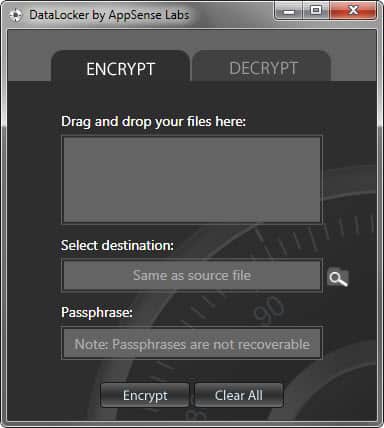
When you install the program you see a basic interface where all of the encrypting and decrypting takes place.
The program will save the encrypted files by default in the same directory the source file is stored in. This is great if you want to secure your local files. If you want to move them to the cloud, you need to manually move them into the right directory or copy them over. Doing that is not overly comfortable though, especially since you can only encrypt files and not folders and all of the files stored inside.
To encrypt files, drag and drop them into the program interface, select a password and change the destination directory if you want. Encrypted files are saved with an ALK extension on the system.
Decrypting works in the same way, only that you need to drag and drop the encrypted files into the program interface instead.
DataLocker is a simple program. It could use a few settings that would make it more usable, like the ability to encrypt folders or better automation to move encrypted files directly into the Dropbox folder.
The Windows version of the program supports both 32-bit and 64-bit editions of the operating system. It requires the Microsoft .NET Framework 4.0 to be installed on the system. (via Caschy )
Enjoyed the article? : Then sign-up for our free newsletter or RSS feed to kick off your day with the latest technology news and tips, or share the article with your friends and contacts on Facebook or Twitter.


Five Best File Encryption Tools

File encryption is your best bet if you want to keep The Man, foreign spies, or your annoying roommates out of your files. Here's a look at five of the most popular encryption tools Lifehacker readers use to lock down their files.

GNU Privacy Guard (Windows/Mac/Linux, Free)

Five Best File Encryption Tools
GNU Privacy Guard (GnuPG) is an open-source implementation of the famed Pretty Good Privacy (PGP) encryption tool—you can read the very interesting history of PGPand how GnuPG came to be here. GnuPG is a volume and individual file encryption tool with support for a dozen encryption schemes, paired keys, and expiring signatures. GnuPG doesn't only provide rock-solid local file encryption; it is, thanks to paired encryption and public key servers, a great tool for encrypted communication. Please note, regular old GnuPG is a command line tool. Check out the list of graphical wrappers and application plug-ins for various operating systems here. The screenshot above is from Cryptophane, a graphical Windows interface for GnuPG.

Disk Utility (Mac, Free)

Five Best File Encryption Tools
Disk Utility is a diverse tool that handles almost any disk-related tasks you'd need on OS X. The utility is capable of creating secure disk images and file volumes encrypted with AES 128-bit or 256-bit encryption. Like most native Mac utilities and applications, Disk Utility and the accompanying encryption blends seamlessly into the OS X experience and makes mounting and unmounting encrypted volumes a breeze. If you've never created an encrypted disk using Disk Utility before, take a look at our previous guide.

TrueCrypt (Windows/Mac/Linux, Free)

Five Best File Encryption Tools
TrueCrypt is a free, powerful, and on-the-fly disk encryption tool. With TrueCrypt, you can create secure encrypted virtual disks or even encrypt entire drives. TrueCrypt is an on-the-fly encryption tool, meaning files are decrypted as you access them and modify them and then encrypted when not in use. Thanks to various optimization tricks and full utilization of the power of modern processors, working within a TrueCrypt volume feels no different than working on a regular unsecured disk. TrueCrypt not only offers strong and transparent encryption—it also offers the ability to create hidden volumes within encrypted volumes for even more secure (and obscured) file protection.

7-zip (Windows, Free)

Five Best File Encryption Tools
Compared to some of the heavyweights in this Hive Five (like GnuPG and TrueCrypt), it might be easy to dismiss the popular file compression tool 7-zip as a lightweight. 7-zip fills a perfect niche for many people, however, by offering simple ZIP container-based encryption. If you're not interested in encrypting a ton of files or maintaining an entire encrypted volume, but you still want to make sure important documents like tax returns or other Social Security bearing documents are locked up tight, 7-zip sports strong AES-256 encryption. Create a new compressed archive, throw your files in it, and slap a password on. Your files are strongly encrypted and stored right alongside your regular documents.

AxCrypt (Windows, Free)

Five Best File Encryption Tools
AxCrypt is a free encryption tool for Windows. Once installed it integrates with the Windows shell and offers simple right-click encryption and decryption of files with AES-256 encryption. Your entire interaction with AxCrypt can take place exclusively from the right-click context menu. In addition to integrating with Windows and offering easy encryption and decryption, you can also use the tool to create self-extracting archives to securely transport files or transfer them to a friend—no AxCrypt installation necessary at the other end.

Related Articles:
Blowfish Advanced File Encryption and Security Tool
Avoiding EFS Encryption Disasters in Windows
Text Encryption Made Easy With Scrambled Egg
Encrypt Instant Messaging with Pidgin Encryption
BoxCryptor, Dropbox Realtime Encryption 

Saturday, February 18, 2012

Top 10 Downloads That Enhance Mac OS X's Built-In Tools


Mac OS X has a ton of great features, but there's always room for improvement. Many developers have felt the same and created a bunch of great apps to enhance OS X's capabilities. Here are our top 10 apps that can power up your Mac to the next level.
Wish this post was about Windows downloads? It was last week !

10. unDock


When you have a bunch of drives connected to your Mac—whether they're mounted via the network or physically attached—it can be annoying to have to manually go through and eject them all. UnDock solves that problem by adding a global hotkey, plus an option in your menubar, to eject them all at once. This is super helpful when you're running out the door and need to disconnect everything safely and quickly.
Download unDock

9. TotalTerminal


Previously known as Visor, TotalTerminal is an enhancement to Terminal, the OS X command line app, that makes a terminal window drop down from underneath your menubar on command. You just pick a shortcut, press the relevant keys, and a Terminal window will drop down. It works just like any standard Terminal window, allowing you to add tabs and choose a style.
Download Total Terminal

8. RestoreMeNot


OS X Lion brought us Restore, a great feature that lets you reboot your Mac and watch all your apps restore themselves to the state they were in before you restarted. In many cases, this is very nice. With some apps, it can get kind of annoying. RestoreMeNot is a system preference pane that allows you to choose which apps will not restore when you reopen them or restart your computer.
Download RestoreMeNot

7. ITEM


OS X offers some really handy pre-configured function keys with its laptop and external keyboards, but some apps (like Adobe Flash) make use of function keys for their keyboard shortcuts. This means you either have to press the Fn key along with the desired function key at the top of your keyboard or temporarily turn off Apple's function key features in the Keyboard system preference pane. Both options aren't ideal, but Palua solves this problem by offering up a hotkey that toggles the mode of your function keys. If you need to switch modes often, this is an enhancement you should download.
Download Palua

6. HyperDock


HyperDock enhances your dock by adding several types of awesome previews. It can preview app windows, display iCal events, and even control iTunes. All you have to do is hover over a dock icon and it will work its magic. HyperDock also allows you to easily resize windows by holding down a modifier key and moving your mouse, can let you snap windows to the edge of the screen, and offers plenty of handy shortcuts to save you time.
Download HyperDock

5. ScreenSharingMenulet


ScreenSharingMenulet is one of my favorite enhancements in Mac OS X. It displays available machines on the network that can be controlled via Mac OS X's built-in screen sharing functionality (a.k.a. VNC ). You can also manually add remote computers so you can easily connect when you're away from your local network. It's a very simple utility, but if you do a lot of screen sharing it will become your new best friend.
Download ScreenSharingMenulet

4. Hyperspaces


Spaces is OS X's built-in virtual desktop feature, and it is pretty nice on its own. If you use it and love it, you'll want to check out Hyperspaces. It'll let you name your spaces, assign different desktop pictures to each space, add labels, and assign specific keyboard shortcuts as well. It also provides tons of built-in shortcuts so you can easily manage your spaces from the keyboard. If you want more out of your virtual desktops than OS X can provide, give Hyperspaces a try.
Download Hyperspaces

3. Cobook


Cobook is our top pick among the Address Book apps for OS X , but while it's definitely its own app it is also an enhancement to the OS X Address Book. Cobook uses the same data already in Address Book, but helps keep it up-to-date by syncing with social web apps like Facebook and LinkedIn. It also provides a quick access from your menubar and is smart enough to understand what you're typing. This makes it easy to add a phone number to a contact or search for specific information without having to worry about telling Cobook what you're typing. It makes contact management on your Mac much easier.
Download Cobook

2. Perian


Perian is known as the swiss-army knife for Quicktime because it takes Quicktime's paltry codec support and makes it capable of playing pretty much any video file you can throw at it. This not only boost Quicktime Player's capabilities, but any Quicktime-compatible application. Even if you use another player, such as VLC, it's really helpful to have Perian installed so OS X doesn't refuse to work with a video file when needed.
Download Perian

1. TotalFinder


Wish that the OS X Finder offered tabbed browsing, a dual-window viewing mode, was able to display folders on top of files in lists, and offered proper cut and paste support? TotalFinder does all of that, plus quite a bit more. If you're not satisfied with the Finder as-is, it's the best OS X enhancement you're going to find. It'll make your $18 poorer, but that's a small price to pay for a number of features the Finder has been lacking for many years.
Download TotalFinder

Thursday, February 09, 2012

Chrome Update Adds Omnibox Prerendering and Scanning Protection


Google has just released an update for the Chrome browser's stable branch that fixes several security vulnerabilities and adds several new features to the browser. The two most prominent feature additions in Chrome 17 are Omnibox Prerendering and Download Scanning.

Omnibox Prerendering basically preloads some of the pages that are presented to you in the browser's address bar. This reduces the time between hitting the Enter key on the keyboard and seeing the page fully rendered in the browser window. It is not clear how Chrome selects those pages, but it is likely that your previous browsing history and bookmarks may have something to do with it. This does create some overhead though, especially if the browser does not select the right pages that often.
The second new feature is the automatic scanning of executable files like exe or msi in Chrome to warn you if you are downloading a malicious file or a file from a host that is know to host a high percentage of malicious downloads.
Google maintains a whitelist of files that are not checked. All other files are checked with Google to retrieve more information. While not a fail safe approach, it can warn users if they are about to download known malicious files. The concept looks similar to Microsoft's SmartScreen Filter. It does not seem possible to disable the feature right now in the browser.
In addition, a total of 20 security vulnerabilities were closed in Chrome 17 of which one received the highest possible severity rating of critical.
You can read up on the changes at the official Chrome Release blog . Chrome updates should already been applied to existing Chrome Stable installations. You can verify the version with a click on Wrench > About Google Chrome. There you can also download and apply the update if the browser has not been updated yet.