Showing posts with label piracy. Show all posts

Thursday, February 23, 2012

Microsoft, Google and Netflix want to add DRM-hooks to W3C HTML5 standard


Microsoft, Google and Netflix want to add DRM-hooks to W3C HTML5 standard


A proposed anti-copying extension for the WC3's standard for HTML5 has been submitted by representatives of Google, Microsoft and Netflix. The authors take pains to note that this isn't "DRM" — because it doesn't attempt to hide keys and other secrets from the user — but in a mailing list post, they later admitted that this could be "addressed" by running the browser inside a proprietary hardware system that hideverything from the user.

Other WC3 members — including another prominent Googler, Ian Hickson — have called for the withdrawal of the proposal. Hickson called it "unethical." I agree, and would add "disingenuous," too, since the proposal disclaims DRM while clearly being intended to form a critical part of a DRM system.
In an era where browsers are increasingly the system of choice for compromising users' security and privacy, it is nothing short of madness to contemplate adding extensions to HTML standards that contemplate designing devices and software to deliberately hide their workings from users, and to prevent users from seeing what they're doing and changing that behavior if it isn't in their interests.
Writing on Ars Technica, Ryan Paul gives a good blow-by-blow look at the way that this extension is being treated in the W3C:
Mozilla's Robert O'Callahan warned that the pressure to provide DRM in browsers might lead to a situation where major browser vendors and content providers attempt to push forward a suboptimal solution without considering the implications for other major stakeholders.
Some of the discussion surrounding the Encrypted Media proposal seem to validate his concerns. Mozilla's Chris Pearce commented on the issue in a message on the W3C HTML mailing list and asked for additional details to shed light on whether the intended content protection scheme could be supported in an open source application.
"Can you highlight how robust content protection can be implemented in an open source webrowser?" he asked. "How do you guard against an open source web browser simply being patched to write the frames/samples to disk to enable (presumably illegal) redistribution of the protected content?"
Netflix's Mark Watson responded to the message and acknowledged that strong copy protection can't be implemented in an open source Web browser. He deflected the issue by saying that copy protection mechanisms can be implemented in hardware, and that such hardware can be used by open source browsers.
"Unethical" HTML video copy protection proposal draws criticism from W3C reps(Thanks, Rob! )

DataLocker, File Encryption For Windows, Mac, iOS


With cloud hosting taking over much of what we are hosting locally right now in the next ten years or so, it becomes important to protect your remotely saved data from unauthorized access. Some cloud hosting providers encrypt the data automatically, but that is still no guarantee that your data is safe. The algorithm used might be flawed, or the company might retain the right to decrypt your data at any time. This can for instance happen when authorities ask them to do that.


The only solution to this problem is to encrypt your data on your own before you shove it into the cloud. We reviewed BoxCryptor before which added an encrypted layer around your data before it was transferred to Dropbox.
DataLocker provides a similar service. The program is available for Windows and Mac operating system, as well as mobile systems running Apple's iOS system (iPad and iPhone currently only).
You need to request the software on the developer site by filling out a form there. The download link will be in the email that you receive after filling out the form.
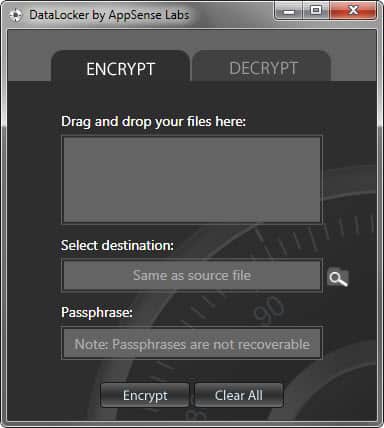
When you install the program you see a basic interface where all of the encrypting and decrypting takes place.
The program will save the encrypted files by default in the same directory the source file is stored in. This is great if you want to secure your local files. If you want to move them to the cloud, you need to manually move them into the right directory or copy them over. Doing that is not overly comfortable though, especially since you can only encrypt files and not folders and all of the files stored inside.
To encrypt files, drag and drop them into the program interface, select a password and change the destination directory if you want. Encrypted files are saved with an ALK extension on the system.
Decrypting works in the same way, only that you need to drag and drop the encrypted files into the program interface instead.
DataLocker is a simple program. It could use a few settings that would make it more usable, like the ability to encrypt folders or better automation to move encrypted files directly into the Dropbox folder.
The Windows version of the program supports both 32-bit and 64-bit editions of the operating system. It requires the Microsoft .NET Framework 4.0 to be installed on the system. (via Caschy )
Enjoyed the article? : Then sign-up for our free newsletter or RSS feed to kick off your day with the latest technology news and tips, or share the article with your friends and contacts on Facebook or Twitter.


Five Best File Encryption Tools

File encryption is your best bet if you want to keep The Man, foreign spies, or your annoying roommates out of your files. Here's a look at five of the most popular encryption tools Lifehacker readers use to lock down their files.

GNU Privacy Guard (Windows/Mac/Linux, Free)

Five Best File Encryption Tools
GNU Privacy Guard (GnuPG) is an open-source implementation of the famed Pretty Good Privacy (PGP) encryption tool—you can read the very interesting history of PGPand how GnuPG came to be here. GnuPG is a volume and individual file encryption tool with support for a dozen encryption schemes, paired keys, and expiring signatures. GnuPG doesn't only provide rock-solid local file encryption; it is, thanks to paired encryption and public key servers, a great tool for encrypted communication. Please note, regular old GnuPG is a command line tool. Check out the list of graphical wrappers and application plug-ins for various operating systems here. The screenshot above is from Cryptophane, a graphical Windows interface for GnuPG.

Disk Utility (Mac, Free)

Five Best File Encryption Tools
Disk Utility is a diverse tool that handles almost any disk-related tasks you'd need on OS X. The utility is capable of creating secure disk images and file volumes encrypted with AES 128-bit or 256-bit encryption. Like most native Mac utilities and applications, Disk Utility and the accompanying encryption blends seamlessly into the OS X experience and makes mounting and unmounting encrypted volumes a breeze. If you've never created an encrypted disk using Disk Utility before, take a look at our previous guide.

TrueCrypt (Windows/Mac/Linux, Free)

Five Best File Encryption Tools
TrueCrypt is a free, powerful, and on-the-fly disk encryption tool. With TrueCrypt, you can create secure encrypted virtual disks or even encrypt entire drives. TrueCrypt is an on-the-fly encryption tool, meaning files are decrypted as you access them and modify them and then encrypted when not in use. Thanks to various optimization tricks and full utilization of the power of modern processors, working within a TrueCrypt volume feels no different than working on a regular unsecured disk. TrueCrypt not only offers strong and transparent encryption—it also offers the ability to create hidden volumes within encrypted volumes for even more secure (and obscured) file protection.

7-zip (Windows, Free)

Five Best File Encryption Tools
Compared to some of the heavyweights in this Hive Five (like GnuPG and TrueCrypt), it might be easy to dismiss the popular file compression tool 7-zip as a lightweight. 7-zip fills a perfect niche for many people, however, by offering simple ZIP container-based encryption. If you're not interested in encrypting a ton of files or maintaining an entire encrypted volume, but you still want to make sure important documents like tax returns or other Social Security bearing documents are locked up tight, 7-zip sports strong AES-256 encryption. Create a new compressed archive, throw your files in it, and slap a password on. Your files are strongly encrypted and stored right alongside your regular documents.

AxCrypt (Windows, Free)

Five Best File Encryption Tools
AxCrypt is a free encryption tool for Windows. Once installed it integrates with the Windows shell and offers simple right-click encryption and decryption of files with AES-256 encryption. Your entire interaction with AxCrypt can take place exclusively from the right-click context menu. In addition to integrating with Windows and offering easy encryption and decryption, you can also use the tool to create self-extracting archives to securely transport files or transfer them to a friend—no AxCrypt installation necessary at the other end.

Related Articles:
Blowfish Advanced File Encryption and Security Tool
Avoiding EFS Encryption Disasters in Windows
Text Encryption Made Easy With Scrambled Egg
Encrypt Instant Messaging with Pidgin Encryption
BoxCryptor, Dropbox Realtime Encryption 

Monday, February 13, 2012

BitTorrent doesn’t hurt US box-office, delayed international releases drive downloading


Economics researchers at Wellesley College and U Missouri have published a study showing that feature films' US box office returns are not correlated to BitTorrent sharing. They also show that shorter delays between the US exhibition and overseas releases result in less file-sharing — that is, people outside the US download movies because they can't buy tickets to them.


The second point is an important one. There's only one Internet, networked culture doesn't respect national boundaries. A particularly effective marketing campaign for a new release in America will stimulate demand in other countries, and if there's no legitimate way to fulfill demand, then some portion of viewers will choose illegitimate routes. For example, the new Muppets movie has only just been released in the UK, some months after the US theatrical release (which was attended by enormous publicity). Presumably, someone at a studio concluded that there were too many UK movies in the pipeline at Christmas and not enough in February, and chose to delay the film's release to now. However, a certain portion of the audience for Muppet movies have been reading reviews, watching viral YouTube clips, and sitting through extended online discussions of the movie without being able to see it and participate. I'm pretty sure that a lot of these people downloaded the movie so that they could be a part of this moment.
Maybe they'll still buy tickets to the cinema, too. I'd guess that a lot of middle-class families with small children will do this. There aren't many kids' movies in cinematic release at the moment, and Muppets is certainly the best bet for a Sunday matinee during the record-breaking cold-snap, when no one wants to take the kids to a park on the weekend. But child-free adults who love the Muppets may well have slaked their thirst, and there are a lot of adults in the Muppet cohort, and adults who like kids' movies often complain about paying a lot of money to attend screenings that are disrupted by crying, talking, squirming children. If you've already seen the movie on your computer, that may be enough. Finally, there are families in the "squeezed middle" who are struggling to pay the bills may want to see the movie in the cinema, but simply lack the funds to do so, and the amount of time that's gone past since the initial release has meant that there are more online copies and that they're easier to download (for example, more BitTorrent seeds) than ever before. For them, the delayed release makes downloading easier and more attractive.
"Anti-piracy" efforts are often painted as life-or-death struggles for the studios. But in the case of international windows, this is about profit maximization, not survival. If the studios can outsource the titanic expense of policing copyrights in delayed-release nations to the countries themselves, they can wring a few more points of profit by delaying release to an otherwise optimum moment. But considered as a societal problem, it makes no sense to spend a million euros on copyright enforcement just so Universal can save a few thousand euros on the cost of making new 35mm prints.
Here's the study: Reel Piracy: The Effect of Online Film Piracy on International Box Office Sales , by Brett Danaher (Wellesley College - Department of Economics) and Joel Waldfogel (University of Minnesota - Twin Cities - Carlson School of Management ; National Bureau of Economic Research (NBER); University of Minnesota - Twin Cities - Department of Economics).
"Consumers in the US who would choose between the box office and piracy choose the box office (and the remaining US pirates had valuations lower than the ticket price) but that international consumers who would consider both options choose piracy due to a lack of legal availability," wrote the researchers. "If piracy displaced box office sales in the US, we would have expected the slope of the returns profile to shift more significantly as BitTorrent became more widely adopted."
In other words, researchers were unable to discern an irregular drop in returns of domestic box office sales, which could fault BitTorrent as the culprit.
Despite the mounting evidence and studies providing evidence to the needlessness of the movie studios' assault against file-sharing services, their attacks have been intensifying. At the end of the day, these results suggest that, while directing the blame at file-sharing services induces the fear of prosecution among other file-sharing competitors, much of the power to curb piracy remains in the hands of the studios.

Video of Multibeast - Hackintosh's Best Friend OSx86


We give you a basic overview of Multibeast—the handy hackintosh post-installation tool by tonymacx86 and MacMan—in our always up-to-date guide to building a hackintosh , but just enough to give you the basics. In the video above, hackintosher StingRay walks you through every little detail of MultiBeast so you can get to know one of the most vital tools for the process.
In addition to detailing each option in MultiBeast, StingRay explains the best practices involved for each choice you make. Although MultiBeast is an easy tool to use, it can be a little confusing the first time around because it's unfamiliar territory. If you're planning on building a hackintosh, you'll want to watch this video so you're prepared and ready for the job.
Multibeast Overview Video | tonymacx86 blog

Thursday, February 09, 2012

RIAA Chief Whines That SOPA Opponents Were "Unfair"


First time submitter shoutingloudly writes "In a NY Times op-ed today, RIAA chief Cary H. Sherman accuses the opponents of SOPA of having engaged in shady rhetorical tactics . He (wrongly) accuses opponents such as Wikipedia and Google of having disseminated misinformation about the bills. He lashes out at the use of the term 'censorship,' which he calls a 'loaded and inflammatory term.' Most /. readers will get the many unintentional jokes in this inaccurate, hypocritical screed by one of the leaders of the misinformation-and-inflammatory-rhetoric-wielding content industry lobby." A gem: "As it happens, the television networks that actively supported SOPA and PIPA didn't take advantage of their broadcast credibility to press their case. That's partly because 'old media' draws a line between 'news' and 'editorial.' Apparently, Wikipedia and Google don't recognize the ethical boundary between the neutral reporting of information and the presentation of editorial opinion as fact."

Saturday, February 04, 2012

Lawsuit: You Can't Charge Me With Downloading Porn Because You Can't Copyright Obscenity


For the first several years of the entertainment industry's crackdown on online piracy, American pornographers did very little to go after the people who filled up gigabyte after gigabyte of hard drive space with bittorrented x-rated material. But in recent years, realizing there is money to be made by merely threatening "John Doe" defendants with making their names and downloading habits public, that has begun to change. But one California woman is fighting back, claiming that the porn she didn't violate copyright laws because the porn she's accused of downloading isn't copyrightable.
First off, the plaintiff in the case says she never downloaded the particular flesh flick she's been accused of acquiring illegally. And even if she had bittorrented the movie, she says that she and others being targeted by a litigious porn company did nothing wrong in the first place.
The woman goes all the way back to the Founding Fathers for her explanation of why copyright law doesn't pertain in this case.
From the lawsuit:
Article I, Section 8, Clause 8 of the United States Constitution, known as the Copyright Clause, empowers the U.S. Congress "To promote the Progress of Science and useful Arts, by securing for limited Times to Authors and Inventors the exclusive Right to their respective Writings."
Thus, copyright is authorized only for works which promote the progress of science and the useful arts.
Horizontal Stare Decisis or Circuit law binds all courts within a particular circuit, including the court of appeals itself… "[T]he first panel to consider an issue sets the law not only for all the inferior courts in the circuit, but also future panels of the court of appeals… Once a panel resolves an issue in a precedential opinion, the matter is deemed resolved, unless overruled by the court itself sitting en banc, or by the Supreme Court" or "unless Congress changes the law.")
Early Circuit law in California held that obscene works did not promote the progress of science and the useful arts, and thus cannot be protected by copyright.
Subsequent non-en banc decisions by the Ninth Circuit failed to follow this prior circuit decision in California.
Given the absence of any subsequent en-banc Ninth Circuit decisions, Supreme Court precedent, or changes in the Constitution that copyright is authorized for works which does not promote the progress of science and the useful arts, the subsequent Ninth Circuit decisions are void and do not constitute binding precedent.
[Defendant]'s work does not promote the progress of science.
[Defendant]'s work does not promote the useful arts.
[Defendant] has judicially admitted that its work is adult pornography.
[Defendant]'s work depicts obscene material.
Plaintiff is informed and believes, and thereon alleges that to create the work, [Defendant] and its agents and/or its employees violated laws which prohibited pimping, pandering, solicitation and prostitution, including any claims of conspiracy.
[Defendant]'s work depicts criminal acts and/or conduct.
[Defendant]'s work is not copyrightable.
She also alleges that the pornographer knowingly allowed users of bittorrent sites to post this movie and others without issuing a DMCA take-down notice, thus turning these sites into "honeypots so they could continue to log IP address[es]" of users for future litigation.
Once porn companies put a name to that IP address, it's not uncommon for them to threaten litigation that would seek six-figure penalties and result in the public knowing that defendants downloaded x-rated films. Many defendants settle for a few thousand dollars with the hope that they remain listed as "John Doe."

Is Pornography Copyrightable? [Courthouse News]